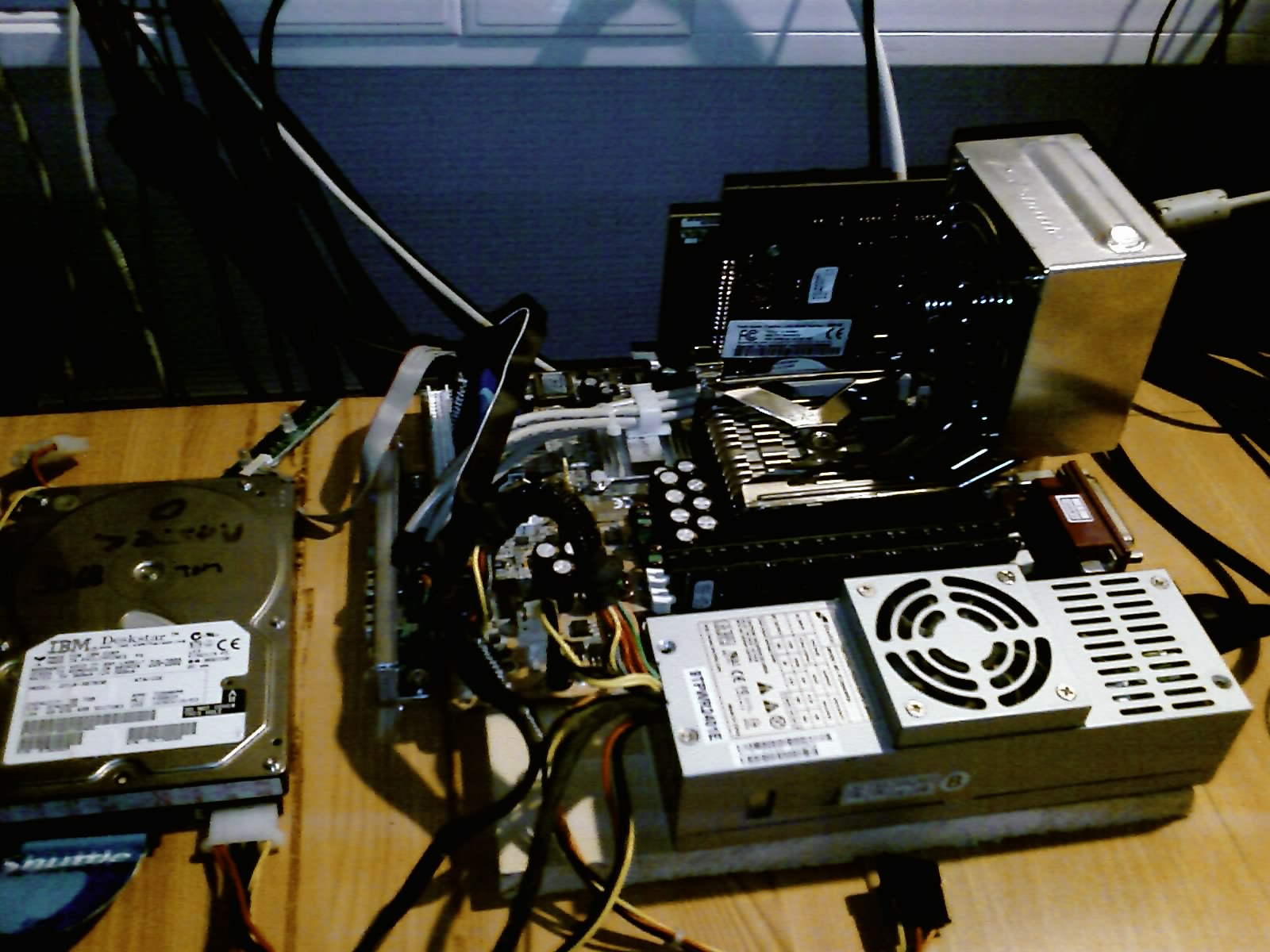
This is a repost of something I tagged on the end of a post about using waveblaster cards without a PC.
OK now for another, totally opposite idea.
How many AWE32’s etc can you fit in a PC?
How about using an old PC using a basic OS/driver to run say 4 AWE32/64’s as voices? MIDI in, and perhaps a MIOS based control surface. Something using a low power CPU, then it wouldn’t need fancy fan cooling, run with minimal IO and graphics card for setting up. The AWE64 Golds is/was quite reasonable. I use one in my MP3 machine, because it has proper phono sockets. Given the (free) price of old PC’s, I wonder if this is worth trying as a recycle? I’ve got two AWE32’s sitting here, that I can’t bear the thought of stripping for chips, (I mean, paid £120 for one way back when - I don’t think I had a night out for 2 months to afford it!).
Is this a thought? Even as a sample player it might be worth a try. I do like the thought of ‘old PC as appliance’ - like my smoothwall, another excellent community project. http://www.smoothwall.org/
My original idea was to get the PC to act as loader/controller for several old cards, I can see that there are 3 addresses available, though with soundblaster you might run out of DMA’s. You could save IRQ’s by ditching the serial and parallel ports, and perhaps even the floppy, at run time. I had this vision of benig able to get 3 or 4 x 32 soundfont voices, and all with parts that were essentially free. I’d use an ISA bus motherboard, and a very stripped down OS. Like this http://www.litepc.com/products.html. They do an embedded Win98 that is rommable and costs $25. They quote boot times of less than 4 seconds. If I could get it to boot from flash I’d be a very happy bunny. Store the sound samples etc on a laptop drive for quiet and cool. I had initially thought of a LINUX core set up especially, but the WinLite products mean no messing with drivers etc, it might be possible to get a ‘quick and dirty’ system up fast. The only real programming effort would be in the HUI.
Internally, some work on the power supply, such as seperate power for the backplane, and some shielding might go some way to keeping the PC’ background hash out of the audio, and the current pull of a laptop hard drive woudl prevent the seek noise breakthrough I’ve had several times.
So my take was cheap PC hardware. Make a big stand alone expander based on old soundcards. A portable VST host sounds cool too, though a lot more CPU horsepower would be needed.
Shuttle mainboard (small-ish formfactor) not shure if Shuttle use ATx / miniAtx or their own formfactor.
Plan is to remove the agp graphic card after system install, get a pci raisercard and modify the cpu fan.
CPU fan… I plan to put this motherboard in a 2U enclosure (it’'s now 3U high), use a 120mm papst (or equivalent) fan. I then need to control the airflow in some way to a passive cooler on the cpu. (often used in small formfactor pc’s like home-entertainment systems)
Challenge: PCI raisercard… Anyone seen a raisercard that enables me to mount the pci card to the left of the motherboard? The ones I’ve seen allways “raise” the pci cards to the right (seen from front to backplane).
Storage:
To keep the heat / noice to a minimum I hope use alternative sollitions to normal spinning harddrives like:
I don’t plan to show any of the “PC” connection to the outside of the enclosure. Would be nice tho to have easy access to storagemedia (sd card or oemsata) from the frontpanel (kind of like a mediareader type..)
Don’t forget DOS ;D Okay, it’s single tasking, but there’s some interesting programs on that site, and your hardware overhead will be lower than even a stripped Win98.
For example:
“Midget is a DOS-based MIDI music program, which features support for General MIDI and Yamaha XG devices.”
“QSEQ is a complete sequencer for DOS/SoundBlaster, using both external MIDI and internal FM synth. A FM editor is included”
Elsewhere: “Converter 1.5 is a very powerful and flexible real-time application providing an advanced MIDI input processor, clock sync’ed LFO to MIDI generators, filter bank -based audio to MIDI converter, gameport or joystick to MIDI converter, and mouse or touchpad to MIDI converter in an all-in-one solution. … on older 486 or Pentium computers.”
Harmony Central also has a DOS archive - pretty out of date, but there are some leads there worth following up.
Also check out Blue - a MIDIboxer’s 2003 built embedded DOS keyboard, using AXS, an all-in-one softsynth, sequencer, drum machine, sampler, that also runs under Windows.
While we’re on the subject of riser cards, if you’re thinking of using a laptop, there are adapters for mounting full PCI cards in a MiniPCI socket. Some newish laptops use MiniPCI for a modem, NIC or WiFI card.
Dos: Like the idea, but I’m not a programmer, and drivers for soundcards etc is my main concern (kx for sblaster cards, windows only for scope range)
Comnverter seem VERY nice!! I have a couple of old Pentiums (fanless ;D) that could serve as host for a standalone converter-ish 1U box… Is it multiclient capable?
I read about the Blue project, it looked very interesting indeed, was it completed? Could not find the axs for dos, only windows…
I don’t plan to use softsynths as I find the asynth for kx suits my needs (same with the drumsynth) / or use my scope Luna II. The main reason for this, is to keep it simple. The controlsurface (midibox) is hard to make “general purpose” to use in many different versions of softsynths.
Creating controlsurface for asynth is easy (as the numbers of controllable parameters are limited (same with drumsunth) I guess I can fit all knobs and buttons in a 2U frontpanel.
I will try to “design” a frontplate with the frontpanel app at a later stage. I have the kxdriver running now with asynth & drumsynth. Im using mbseqV3 & (as of now) a maudio prokey88 keyboard as controlsurface.
A minor thought, since the cards are going to be busy enough without having to act as connectors for the user interface, how about using an LTC and going into the PC serial port: Zero hardware at the PC end
A minor thought, since the cards are going to be busy enough without having to act as connectors for the user interface, how about using an LTC and going into the PC serial port: Zero hardware at the PC end
Mike
I’m not sure if I understand what to try to do with the LTC? LTC (Com) is just another way to communicate with the PC isn’t it? Not sure what the LTC will do as a positive effect… (my attemps so far trying to use a widowz serial to midi driver for
the LTC is not sucsessful, in fact I haven’t yet got it going)
Why use LTC?
Edited: After reading my first post… If using the onboard soundcard then the LTC would be beneficial if there were no gamecontroller port on the mainboard. Still it is h**l to get the driver working…
For dos only synth, I guess the minimum to get sound, is in fact a soundcard, and the availability of dos drivers limits the soundcards to soundblaster-ish cards… and afaik all those cards have a gameport-connector.
(I can’t still figure out why you would use the LTC… :o )