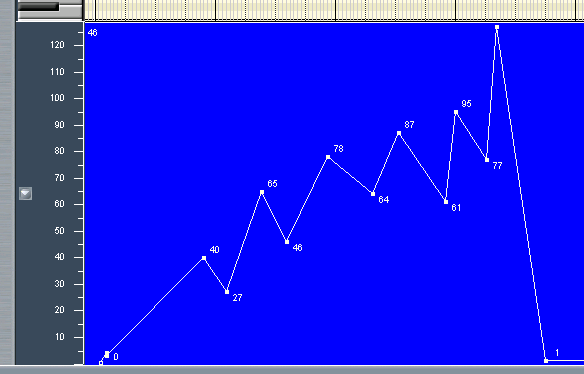
okay i get it now. so you’re aware that the cutoff parameter curve isn’t completely smooth?
yes, it’s a SID specific problem, that the cutoff parameter is not linear
i know that. could you decribe a bit what that flag does? change the curve?
yes, it compensates the non-linearity by re-using the exponent table which is also used to map the oscillator frequency. This works well for the upper frequency range, but not so well for the lower range. But the envelope trick can be used if sweeps within this range are desired.
And again: another possibility is the use of the TB303 option, which reduces the cutoff to the lower range, so that you won’t notice stepiness anymore in the range you are mainly using for these types of sound
i’m talking about 3 different 6581 chips. their filters sound nothing like 2-pole (12dB) filters.
yes, especially the resonance doesn’t really work
i’ve probably read absolutely everything on the subject of SID filters here on ucapps and midibox.org and i’ve also read some other sites. but from the ucapps MBSID page i got the idea that you feel the 6581 filter is better than 8580 filter. i know those tables and samples were updated later but it doesn’t say that the 8580 filter is now better.
the 8580 filter is definitely better for TB303-like sounds, the 6581 is better for soft sounds, I will make this clear in the TB303 tutorial
actually what i wanted to know is whether the cutoff parameter reaches from min to max of the actual SID filter cutoff value. now that i know that i can conclude that the prophet64 wouldn’t sound any better filter-wise than MBSID does. right?
Ok, again a complete statement to avoid any confusion:
Yes, if no modulation source is assigned to the filter, and if the TB303 option is not enabled, you can sweep the cutoff over the whole range with CC#46 - sometimes it sounds steppy because of the 7bit resolution of this CC, but this can be fixed by using modulation sources for fine control.
don’t get me wrong - i don’t want to start a fuss or anything - i hugely respect everything you’ve done and am building my MBSID with great confidence in its powers. it was just that the samples on the prophet64 site got me thinking that MBSID doesn’t use all the headroom of the filter. by the way - i do know how a substractive synth’s soundpath looks like and i’ve built quite a few in reaktor and pd so i have pretty good idea how this works - but just in theory. i haven’t done anything like this in assembler and i understand that there are many limitations/ tricks needed.
Most samples of the Prophet64 side are made with the 8580, when you are activating the TB303 SE option you can realize very similar sounds, because it changes the way how the filter is controled
Best Regards, Thorsten.