Ah forgot about Delta being 6581 so yep that probably explains some of the differences there. Fortunately I was able to find some of my 6582 SIDs stuck in the back corner of one of my hardware parts drawers. Never got to use them much before the CS of my first MB6582 attempt started giving me issues
Even so it’d be fun to experiment around with some of these. Using these when one needs to work around the ADSR bug and such could be useful. The drum engine might be better fit for one of these over a real SID in some ways methinks. Anyways curious what you end up finding when you’re able to compare to SwinSID Ultimate but yeah sounds like ARMSID is a super compelling option! I’d like maybe like one FPGASID but I agree it’s cost prohibitive to populate an entire MB6582 with them. I know TK hinted at driving them with a CORE32 which sounds exciting!
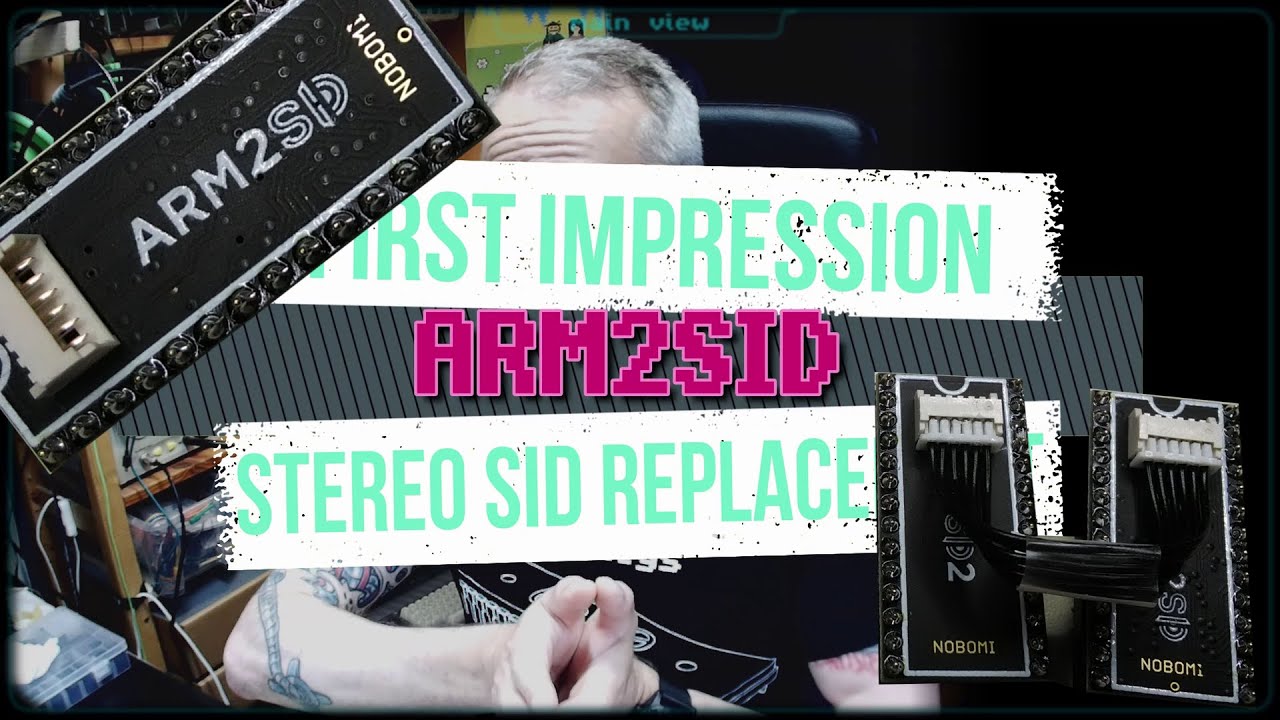
Question: Why should you go for an ARM2SID with second 2SID? 2x ARMSID would work just as well, right? the price difference is not that huge.
: Did something on the PCB have to be changed to connect the second 2SID? Does the 2SID only work in conjunction with the other chip?
The recommendation to modify the board was based on speculation. This turned out not to be necessary in my testing… You can simply drop the Arm2SID set into the required sockets and jam away.
The second (dummy) Arm2SID is basically only there to intercept the Chip Select signal and pass it along to the active Arm2SID, which performs it’s double-duty, then passes the audio-out for the second SID back via the bridge cable.
I’d imagine that the only real reason that someone might want to purchase an Arm2SID over two regular ArmSIDs is to save a little money. The Arm2SID set costs ~48 eur versus two separate ArmSIDs @ 28 eur each or 56 eur for the pair.
So really only a modest savings of ~8 eur per pair, but when you multiply that by the four cores for a fully populated MB-6582, now you’re up to a 32 eur build cost difference.
I bought two pairs of ARM2SIDs, here’s my experience.
The first thing to say is: in my opinion one should not buy one ARM2SID for their MBSID for any reason. Buy two ARMSIDs instead. If it’s true as dwestbury says a few messages above — and it would seem to be true — then the other chip in an ARM2SID pair is a dummy which makes no actual sound; instead the sound of the main chip is just doubled. Obviously that doesn’t produce a stereo sound, only a louder mono sound. Maybe that’s what a C64/128 user needs, but it’s the wrong solution for an MBSID.
Fortunately I could use the main ARMSID from each pair I bought to make one independent pair where each chip produces its own sound. And that sound is very good, I do recommend it (just check dwestbury’s sound samples above). Unfortunately I effectively paid almost double the price for two ARMSIDs because I could use only half of what I bought (ARMSID = 28€ vs ARM2SID = 48€). But that’s the nature of DIY sometimes :-) Hopefully this “research” will benefit someone else!
As to the installation, it was a drop-in affair — no configuration needed on an actual Commodore 64/128 (which I don’t have). Not sure whether it makes any difference, but I’m giving them 9VDC and that seems to work.
it is quite different. If you use ARM2SID with the second SID2 socket, connect it with provided 6 pin wire, and configure it to SOCKET configuration (it is by default) it behaves in 2 SID sockets as 2 SIDs. No doubling the output, ARM2SID has enough processing power so it can process 3 SIDs inside, so in 2 SOCKET configuration it processes both SIDs (the chip select and R/W is brought to the main chip by the wire) and sends the second SID audio back to the SID2 socket by another wire. Thus ARM2SID in socket configuration with SID2 socket and the 6pin wire behaves exactly as 2 ARMSIDs. You can set in configuration one as 8580 and the other one as 6581 or adjust filters and digifix independently.
The option on picture that published above with directly connected wires is for implementing ARM2SID to C64 or similar and when you provide all the addressing by wires, it does not need any stereo adapter and it supports stereo or 3SID or FM emulation, but it needs the additional wires for addressing. With the 2 SOCKET configuration, it can work only as a stereo, not dual mono as jjonas says. The second SID2 socket provides input and output for the 2nd SID emulation, even it is an empty socket conversion placeholder.
NOBOMI reminded me one more feature that can make the second SID (the SID2 socket) play the same music as on the first one. If you do not send any notes to the second SID2 and play only to the first main ARM2SID, it switches itself after 15s to dual mono mode to provide music on both channels, which can make a confusion, that it plays mono. It does not, it just plays the same notes on the second emulated SID.
My message was based on my direct (and relatively uninformed otherwise) experience, where putting an ARM2SID pair into my MB6582 SID synth (connected with the included cable, and replacing two 6581 SIDs which produced a stereo sound) resulted in a mono sound, while putting two “main” chips (taken from two ARM2SID pairs) into the same sockets (without the connecting cable) resulted in a stereo sound. I didn’t change any settings in the chips, or in the synth.
What could explain this? Do you think it can be explained by looking at the ARM2SID pair alone, or should the MBSID harware and firmware be considered as well?
If you have ARM2SID connected by cable to SID2 and place both to two sockets, it should play stereo the same way as two SIDs. If it does not, then there is something wrong. Was the cable fitted correctly on both sides? Are you able to check configuration in some C64? It should be configured this way by default. Could you give me your order number? I will check it. ARM2SID without cable behaves the same way as ARMSID, it is just a little bit expensive
The order number is 002188 (it was shipped on 12 January). Unfortunately I don’t have a C64 available.
I think the cable was correctly connected. But I can test it again, both with the cable and without it, and see if it makes a difference in my situation.
I am sorry for my mistake. The default configuration is set to WIRE, so it is necessary to change the configuration to SOCKET, as dwestbury said. You can use any C64/C128 related computer. We had the SOCKET as default configuration initially, but later we changed the default, as it could cause conflicts in some particular wire configurations, while WIRE is always ok, just the second SID is not addressed in the second socket. If you make a note while ordering the ARM2SID to you order, I can send the ARM2SID configured as SOCKET.