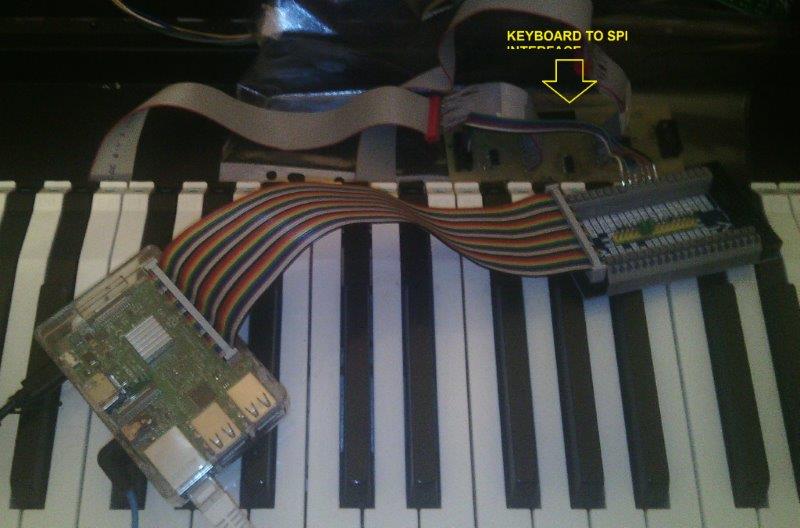
Well, my take on that would be, if you are willing to write all the code yourself and implement it, then go for it. If you want to use something already written and tested, then go with the MB KB. You could always still throw a Pi into it and send the midi out to it for the synthesizer. It seems to me that your would be re-inventing the wheel. I don’t think you would get any performance benefit from a PI, but maybe someone who knows more than me will chime in. A STM32F4 with a core board will cost a bit more than a PI, but it will be ready to go.
For the record, I have not done a midibox kb project. Many years ago, I did make a simple midibox project that would react to 8 foot switches and send midi note signals.
I guess if it were my keyboard, I would prefer to use the MB-KB and make it a regular midi keyboard again. Then I could hook it up to whatever midi stuff I wanted, including a softsynth on a raspberry pi. That being said, I hope it works out for you!
I have this keyboard too, it still works but I started thinking about maintenance.
I can write 8052 asm code easily. Some microcontrollers may be powerful enough. There are fast ones from Silabs (C8051F…) , Microchip/Atmel (AT89LP…) Maxim/Dallas (DS89C430). Then how to calculate key velocity with two contacts ? It seems too expensive to wire each contact to a pin with capture timer, as it would need a lot of slaves scanned by a master that sends MIDI messages. What is the way to do it in software (with external memory if needed, thatcan be accessed without stretched bus cycle), scanning the whole 88 keys each millisecond ?