Definitaly midibox of the century!!
+1 Awesome and totally inspiring!
As to the 4 layers, even more awesome.
Definitaly midibox of the century!!
+1 Awesome and totally inspiring!
As to the 4 layers, even more awesome.
Quite impressive work on those PCB’s, well done on making such flexible modular system!
Guess it took quite some placing/routing time to get it all right.
Why the white soldermask (=expensive), because of reflecting leds, or?
Why not change on one of the 2 “DIN&I2C” connectors, the MISO and MOSI, so u don’t need crossing cables to link them?
Why use such oversized (=expensive) resistor arrays, u would done with >0.125W?
Are those solder jumpers to select adresses?
Your stackup, did u use 2 routing layers and 2 ground/power planes?
Greetz Joost
Quite impressive work on those PCB’s, well done on making such flexible modular system!
Guess it took quite some placing/routing time to get it all right.
Why the white soldermask (=expensive), because of reflecting leds, or?
Why not change on one of the 2 “DIN&I2C” connectors, the MISO and MOSI, so u don’t need crossing cables to link them?
Why use such oversized (=expensive) resistor arrays, u would done with >0.125W?
Are those solder jumpers to select adresses?
Your stackup, did u use 2 routing layers and 2 ground/power planes?
Greetz Joost
Yeah, the routing was difficult. I did it with kicad, it took me i think about 5 attempts.
Regarding your questions:
yes, correct. White soldermask is just a tiny bit more expensive than green at http://www.multipcb.de/. I can really recommend them by the way.
I don’t get that, sorry. I have all module connected in one row, therefore there is one input and one output on each PCB. It connects the DIN and the I2C bus (for the LEDs)
No, 0.125W would not be enough. Each array drives 16 LEDs. Unfortunaltely, the PC!9635 requires resistors, I would have liked a part with constant current regulator, but I did not find one that suited me.
Yes, they determine the I2C address of the driver chip, which has to be different for each chip. There are three on each PCB, one for each color.
Yes, more or less. one signal layer, one ground layer, a mixed power/additional PWM layer and one layer only for PWM (of the LEDs)
I saw this first on Hackaday - I had to come here to find it. I knew it would be a MidiBox.
Anyway, this is completely incredible - sort of what I’ve had in my mind since using Ableton, except about 100x better and more impressive. Congratulations!
Absolutely gorgeous. Please consider posting more details so that we can more easily follow in your footsteps!
Hi i was wondering if you could send me the details of the encoders and push buttons on your huge midi controller, the one with all the led’s. From the images the encoders look very high quality, are they non indented? It would be great if you could give me some info on were to purchase or the manufacturer of these parts, also would these both work in a midibox64e setup without much hastle? Great Controller aswell!
Thanks.
Absolutely awesome! Great build.
Would be interesting to see more of the case work and the interior.
Cheers,
Alex
Hi i was wondering if you could send me the details of the encoders and push buttons on your huge midi controller, the one with all the led’s. From the images the encoders look very high quality, are they non indented? It would be great if you could give me some info on were to purchase or the manufacturer of these parts, also would these both work in a midibox64e setup without much hastle?
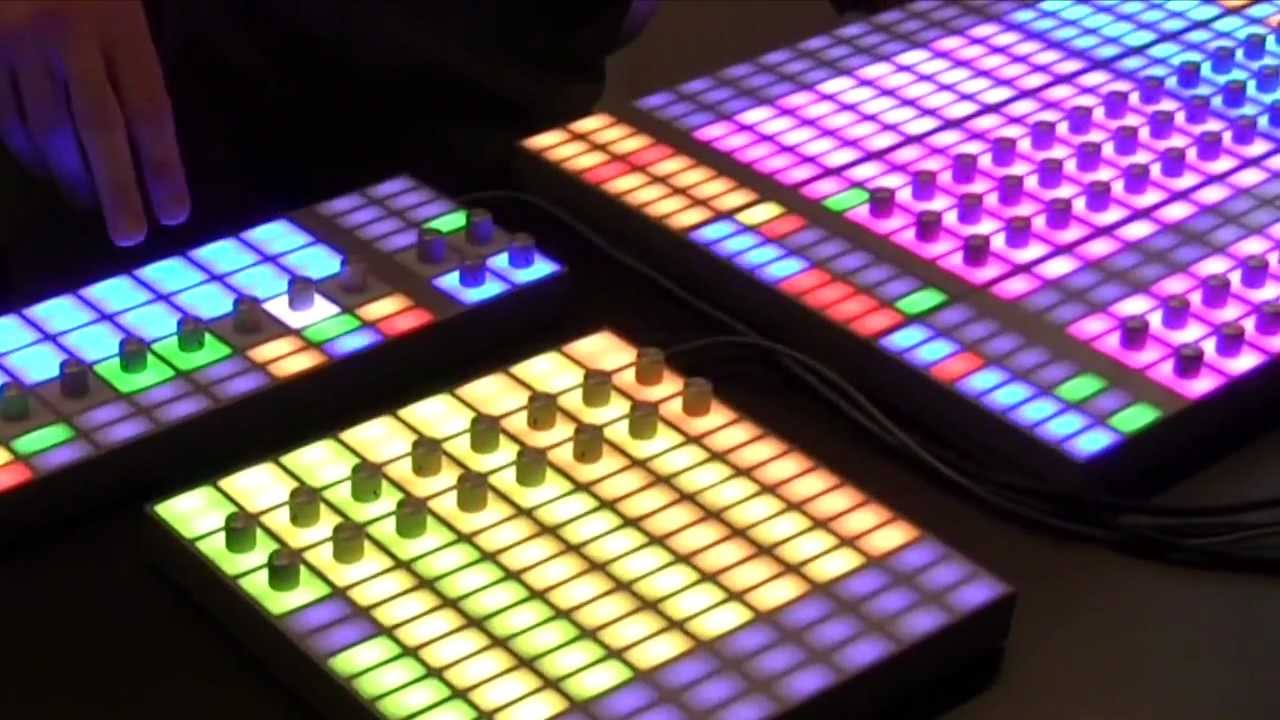
The encoders are standard Bourns PEC11, no special quality there. I did not find any suitable SMD encoders, so for theses parts I had to put some holes into the PCB. This makes it more rugged, so maybe it was a good decision after all. The push buttons are standard SMD pushbuttons, I needed some with very low actuation force, therefore I took the DTSM-65K-V-B from Diptronics. No surprises here, theses parts would work in a normal midibox without problems.
The encoders are standard Bourns PEC11, no special quality there. I did not find any suitable SMD encoders, so for theses parts I had to put some holes into the PCB. This makes it more rugged, so maybe it was a good decision after all. The push buttons are standard SMD pushbuttons, I needed some with very low actuation force, therefore I took the DTSM-65K-V-B from Diptronics. No surprises here, theses parts would work in a normal midibox without problems.
Thanks!! very helpful 
MMMMMMMOOOOOOOOAAAAAAAAAAAAAAARRRRRRRRRRRRR!!! :frantics:

I just love how the camera usually changes angles right on beat at the end of a section. Must be some camera tricks or lots of filmographers.
P.S. I can’t talk, but “lol” at Smithy’s post count ranking 
Thanks Was not really easy…
Record video and audio
sync both in Ableton live
render snippets which are multiples of 8 or four bars, add some overhead on both sides
manually do the camera changes in iMovie using the “precision” editor
I just love how the camera usually changes angles right on beat at the end of a section. Must be some camera tricks or lots of filmographers.
P.S. I can’t talk, but “lol” at Smithy’s post count ranking
Great, Ander! Absolutely brilliant.
Could you explain a little how it works?
insane !
:frantics:
Absolutely stunning! Well done!
Here’s a nice, not too short interview with Ander:
Hi Ander, It’s really Nice DIY Midi controller, can you give Me The instructables how to make the Button arcylic pad and its mechanism ? I know that’s a lot to ask, but i really want to made it on my own, Thank You So Much
AWESOME
Hello, since I just joined, I did not have the time so far to go through all the details of the functions of this device so far, but this is impressing. I wonder in which way you make use of all the illumination. I started a similar project years ago (well much smaller for the first step) but finally dropped these tries and changed to virtual feedback of the controller values in generating VGA based screens in realtime (FPGA based). Honestly I did not have the time and the power to follow this way
Again, this is impressing and somehow it inspires me to create something similar. For the moment I am busy with a project dealing with rotary encoders and RGB-based feedback of the values and also the controlled values in the device.