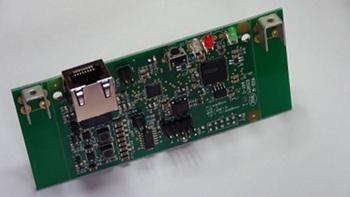
Looking at the picture above it must be a per-piece price, and I’m quite shocked. Given that you need at least two of these (or similar) units, that amounts to a significant sum for a minimal setup… I’d love to be corrected, though!
Things are not so simple with RTP-MIDI. The way it works is very different from classical MIDI approach with the IN/OUT/THRU.
First, you can perfectly build a setup where you have a single KissBox board on one side, and computers on the other. The KissBox modules can talk to each other, but also to computers. So it’s not necessary two modules needed (apart if you want to make a MIDIBox talking to another MIDIBox over the network)
Second point : the particularity with RTP-MIDI is that it is based on the concept of session. A session represents a MIDI IN/OUT pair on application side. The difference with “classical” MIDI is that a single session handler can be connected to multiple session handlers in parallel (it’s not KissBox specific, this is part of RTP-MIDI itself)
I will try to explain it simply : imagine that you have four RTP-MIDI devices on the network (A, B, C, D). When you want to exchange MIDI data, you need first to open a session (this is part of the firmware or the driver in case of the computer. You do not see it really, it’s done transparently).
Let’s say that A, B and C open a session with D (inside D sofware, there are “physically” four sessions then, it’s not the same session shared between all participants). What is sent by A, B and C is sent automatically to the application, after ebing merged. In the other direction, what is send by application to D is sent automatically to A, B and C. In other terms, with RTP-MIDI, you do not need mergers and splitters, they are implicitely part of the protocol.
But B can also be connected virtually to C for example, etc…
This is called virtual patchbay
The current KissBox firmware supports 8 sessions in parallel so 8 devices (which can be computers, not only other KissBox CPU) can talk with a single MIOS application at the same time. The protocol we use on SPI allows up to 16 cables, so basically we can assume that a single RTP-MIDI node represents 16 MIDI cables at the same time (each of them with 16 MIDI channels of course)
The protocol we use on SPI uses the notion of Cable Number, which allows to identify the session sender. So, simply said, at a given moment, the MIOS application can see up to 8 devices, while there is only one physically connected…
Yes, I know, it’s a bit hard to understand since there are many new concepts under RTP-MIDI. If you want, you can take a look on the download page of KissBox website, there are documents which explain more in detail how the configuration process works and what are the possibilities.
Sorry if I am not very clear, I work on RTP-MIDI since 2006, and many things are very clear for me, but not necessarily for newcomers in RTP-MIDI.
If you think that something needs to be explained more in detail, please ask, I will do my best to explain things simply.
Benoit