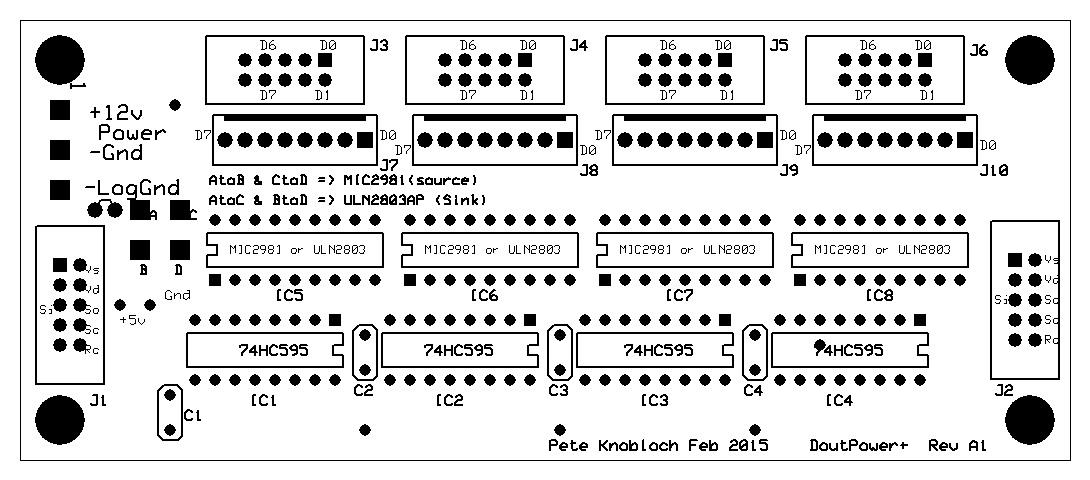
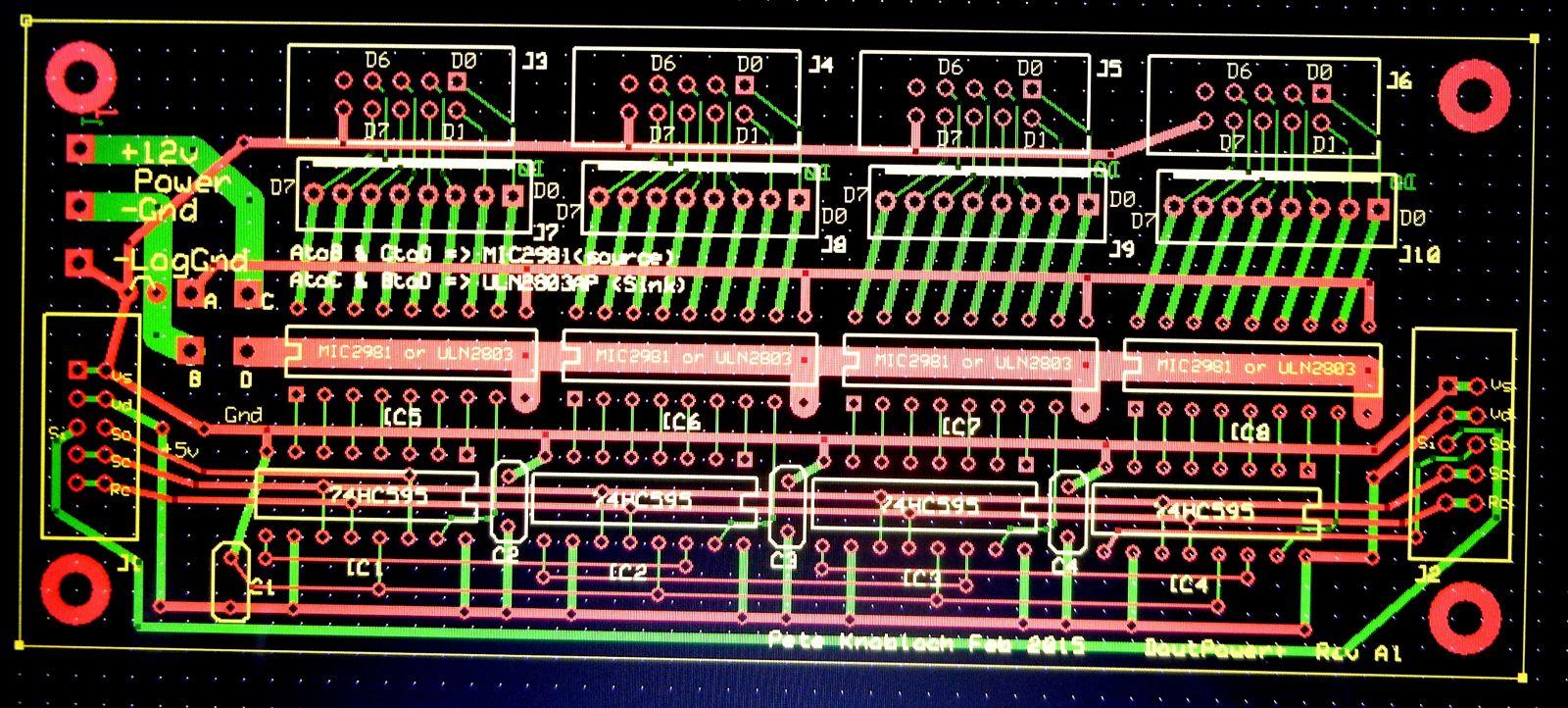
I created a PCB that is pin compatible with the Dout board but is designed for driving solenoids using different parts for either a Sink or Source mode drivers. Hoping to use these boards for driving Stop Action Magnets (SAM’s) in my organ projects. It also allows me to isolate the logic grounds from the driver power grounds. It uses the MIC2981 or the ULN2803 driver chips. I used them because the pin configuration is similar and they seem to be available, at least for now. This board is larger than the Dout board from SmashTV.
I created this PCB that is pin compatible with the Dout board but is designed for driving solenoids using different parts for either a Sink or Source mode drivers. Hoping to use these boards for driving Stop Action Magnets (SAM’s) in my organ projects. It also allows me to isolate the logic grounds from the driver power grounds. It uses the MIC2981 or the ULN2803 driver chips. I used them because the pin configuration is similar and they seem to be available, at least for now. This board is larger than the Dout board from SmashTV.
Hi Pete: Very cool. Do you expect to be able to daisy-chain several of these boards to give you more than 64 outputs? Have you tried that yet. How do you get the MIDIbox to scan more than 64?
They should be able to be daisy-chained just like the Dout boards. I just ordered 40 of these boards for my project and expect them to come in about 2 weeks later. Each board will support 16 SAM’s. Only need 4 boards for the 51 SAM’s on my gutted Conn console. A friend of mine bought my 1930’s Wurlitzer console that he wants to control the 70 or so SAM’s which need a - common driver where I need a + common driver board. That’s why it can be configured for both chip types. Right now I want to use the older MidiBox core8 for the CPU since they are simple and cheep and they are 5 volt compatible. The plan right now is to use NoteOn/Off messages to turn the stops on and off. Will have a timer for each SAM and the core software will turn the drivers OFF after about 100-200ms of being turned ON. Will be using the consoles with Hauptwerk software in a PC.
I hope to be able to control up to 256 outputs (128 Sam’s on 8 DoutPower+ boards) from a single Core8 CPU. Will see if its possible when I start coding. The other problem I don’t know about is how many of these boards will be able to be daisy-chained before having problems with noise. Maybe with careful layout of the grounds and power distribution there is a chance that 8 boards might work.
I am offering a low resistance path but I am also trying to make sure that the power surge doesn’t get introduced directly into the ground of the logic. Under idea conditions the POWER + and - lines of all the DoutPower bds will go to the high current power supply that is floating and not grounded. There is a jumper on the board that can be shorted out that connects the Power - to the logic ground. The only jumper that should be connected is the first one in the Dout chain. This stops any of the high current surges from flowing thru the logic grounds which can upset the shift register states.