Problem solved ;D
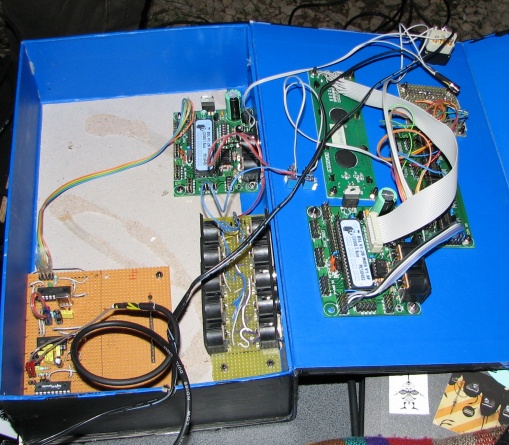
you can find the hex file, the source code and an inside view of Matoz’s clockbox attached to this message
The clockbox works as a standalone BPM generator; but if it received a Play MIDI Byte from another machine it run as slave, until a Stop MIDI byte is received, then the clockbox return to its normal behavior.
Bye
Source code :
/*
* Clockbox (MIDI Clock Sender)
*
* ==========================================================================
*
* Copyright (C) 2005 Thorsten Klose (tk@midibox.org)
*
* ==========================================================================
*
* This file is part of a MIOS application
*
* This application is free software; you can redistribute it and/or modify
* it under the terms of the GNU General Public License as published by
* the Free Software Foundation; either version 2 of the License, or
* (at your option) any later version.
*
* This application is distributed in the hope that it will be useful,
* but WITHOUT ANY WARRANTY; without even the implied warranty of
* MERCHANTABILITY or FITNESS FOR A PARTICULAR PURPOSE. See the
* GNU General Public License for more details.
*
* You should have received a copy of the GNU General Public License
* along with This application; if not, write to the Free Software
* Foundation, Inc., 59 Temple Place, Suite 330, Boston, MA 02111-1307 USA
*
* ==========================================================================
*/
/////////////////////////////////////////////////////////////////////////////
// Include files
/////////////////////////////////////////////////////////////////////////////
#include "cmios.h"
#include "pic18f452.h"
#include "main.h"
#include "mclock.h"
#include "mtc.h"
/////////////////////////////////////////////////////////////////////////////
// Global variables
/////////////////////////////////////////////////////////////////////////////
// status of application (see bitfield declaration in main.h)
app_flags_t app_flags;
/////////////////////////////////////////////////////////////////////////////
// Local variables
/////////////////////////////////////////////////////////////////////////////
//RLUCAS : Mode de la clockbox :
unsigned char sm_mode; // vaut 0 en master, 1 en slave
/////////////////////////////////////////////////////////////////////////////
// This function is called by MIOS after startup to initialize the
// application
/////////////////////////////////////////////////////////////////////////////
void Init(void) __wparam
{
//RLUCAS : on démarre en master
sm_mode=0;
// set shift register update frequency
MIOS_SRIO_UpdateFrqSet(1); // ms
// we need to set at least one IO shift register pair
MIOS_SRIO_NumberSet(NUMBER_OF_SRIO);
// debouncing value for DINs
MIOS_SRIO_DebounceSet(DIN_DEBOUNCE_VALUE);
// Touch sensor sensitivity *must* be 0, otherwise Port D.4 (CORE::J14) cannot be used as Clock Output
MIOS_SRIO_TS_SensitivitySet(0);
// set encoder speed mode of datawheel
MIOS_ENC_SpeedSet(0, DATAWHEEL_SPEED_MODE, DATAWHEEL_SPEED_DIVIDER);
#if MTC_MODE
// initialize the MIDI clock module (-> mclock.c)
MTC_Init();
MTC_FPSSet(3); // type 3: 30 fps
#else
// initialize the MIDI clock module (-> mclock.c)
MCLOCK_Init();
MCLOCK_BPMSet(140);
#endif
}
/////////////////////////////////////////////////////////////////////////////
// This function is called by MIOS in the mainloop when nothing else is to do
/////////////////////////////////////////////////////////////////////////////
void Tick(void) __wparam
{
//RLUCAS :
//if (sm_mode==0) {
#if MTC_MODE
// this routine sends the MTC code if requested
MTC_Tick();
#else
// this routine sends the MIDI clock (and Start/Continue/Stop) if requested
MCLOCK_Tick();
#endif
//}
}
/////////////////////////////////////////////////////////////////////////////
// This function is periodically called by MIOS. The frequency has to be
// initialized with MIOS_Timer_Set
/////////////////////////////////////////////////////////////////////////////
void Timer(void) __wparam
{
//RLUCAS :
if (sm_mode==0) {
#if MTC_MODE
// forward timer event to MTC module (-> mtc.c)
MTC_Timer();
#else
// forward timer event to MIDI clock module (-> mclock.c)
MCLOCK_Timer();
#endif
}
}
/////////////////////////////////////////////////////////////////////////////
// This function is called by MIOS when the display content should be
// initialized. Thats the case during startup and after a temporary message
// has been printed on the screen
/////////////////////////////////////////////////////////////////////////////
// default special character set
// created with http://lcd5x8char.midibox.org
// ;; char #1
// db b'00001000', b'00001100'; line 1 / 2
// db b'00001110', b'00001111'; line 3 / 4
// db b'00001111', b'00001110'; line 5 / 6
// db b'00001100', b'00001000'; line 7 / 8
// ;; char #2
// db b'00000000', b'00000000'; line 1 / 2
// db b'00001110', b'00001110'; line 3 / 4
// db b'00001110', b'00001110'; line 5 / 6
// db b'00000000', b'00000000'; line 7 / 8
// ;; char #3
// db b'00000000', b'00001010'; line 1 / 2
// db b'00001010', b'00001010'; line 3 / 4
// db b'00001010', b'00001010'; line 5 / 6
// db b'00001010', b'00000000'; line 7 / 8
const unsigned char lcd_charset[3*8] = {
0x08, 0x0c, 0x0e, 0x0f, 0x0f, 0x0e, 0x0c, 0x08, // Play
0x00, 0x00, 0x0e, 0x0e, 0x0e, 0x0e, 0x00, 0x00, // Stop
0x00, 0x0a, 0x0a, 0x0a, 0x0a, 0x0a, 0x0a, 0x00, // Pause
};
void DISPLAY_Init(void) __wparam
{
// init default charset
MIOS_CLCD_SpecialCharsInit(lcd_charset);
// clear screen
MIOS_LCD_Clear();
// print default screen
MIOS_LCD_CursorSet(0x00); // first line
#if MTC_MODE
MIOS_LCD_PrintCString("FPS Time");
#else
MIOS_LCD_PrintCString("BPM Meter");
#endif
// request display update
app_flags.DISPLAY_UPDATE_REQ = 1;
}
/////////////////////////////////////////////////////////////////////////////
// This function is called in the mainloop when no temporary message is shown
// on screen. Print the realtime messages here
/////////////////////////////////////////////////////////////////////////////
void DISPLAY_Tick(void) __wparam
{
unsigned char fps;
// do nothing if no update has been requested
if( !app_flags.DISPLAY_UPDATE_REQ )
return;
// clear request
app_flags.DISPLAY_UPDATE_REQ = 0;
// print Play/Stop/Pause char at the right upper corner
MIOS_LCD_CursorSet(0x00 + 15);
#if MTC_MODE
if( mtc_state.PAUSE ) {
MIOS_LCD_PrintChar(0x02); // Pause
} else {
if( mtc_state.RUN ) {
MIOS_LCD_PrintChar(0x00); // Play
} else {
MIOS_LCD_PrintChar(0x01); // Stop
}
}
// print FPS at lower line, left side
MIOS_LCD_CursorSet(0x40 + 0);
switch( MTC_FPSGet() ) {
case 0: fps = 24; break;
case 1: fps = 25; break;
case 2: fps = 30; break;
case 3: fps = 30; break;
default: fps = 0; break;
}
MIOS_LCD_PrintBCD3(fps);
// print the meter at lower line, right side
MIOS_LCD_CursorSet(0x40 + 4);
MIOS_LCD_PrintBCD1(mtc_ctr_hours);
MIOS_LCD_PrintChar(':');
MIOS_LCD_PrintBCD2(mtc_ctr_min);
MIOS_LCD_PrintChar(':');
MIOS_LCD_PrintBCD2(mtc_ctr_sec);
MIOS_LCD_PrintChar('.');
MIOS_LCD_PrintBCD2(mtc_ctr_frame_x_4 / 4);
#else
if( mclock_state.PAUSE ) {
MIOS_LCD_PrintChar(0x02); // Pause
} else {
if( mclock_state.RUN ) {
MIOS_LCD_PrintChar(0x00); // Play
} else {
MIOS_LCD_PrintChar(0x01); // Stop
}
}
// print BPM at lower line, left side
MIOS_LCD_CursorSet(0x40 + 0);
if (sm_mode==1) {
#if MTC_MODE
MIOS_LCD_PrintCString("SLV");
#else
MIOS_LCD_PrintCString("SLV");
#endif
}
if (sm_mode==0) {
MIOS_LCD_PrintBCD3(MCLOCK_BPMGet());
}
// print the meter at lower line, right side
MIOS_LCD_CursorSet(0x40 + 4);
// RLUCAS : Modification pour afficher que des measures multiples de 16 :
// MIOS_LCD_PrintBCD5(mclock_ctr_measures + 1);
MIOS_LCD_PrintBCD5((mclock_ctr_measures & 0x0f) + 1);
MIOS_LCD_PrintChar(':');
MIOS_LCD_PrintChar(' ');
MIOS_LCD_PrintBCD1(mclock_ctr_beats + 1);
MIOS_LCD_PrintChar(':');
MIOS_LCD_PrintBCD3(mclock_ctr_24 * 5);
#endif
}
/////////////////////////////////////////////////////////////////////////////
//  This function is called by MIOS when a complete MIDI event has been received
/////////////////////////////////////////////////////////////////////////////
void MPROC_NotifyReceivedEvnt(unsigned char evnt0, unsigned char evnt1, unsigned char evnt2) __wparam
{
}
/////////////////////////////////////////////////////////////////////////////
// This function is called by MIOS when a MIDI event has been received
// which has been specified in the MIOS_MPROC_EVENT_TABLE
/////////////////////////////////////////////////////////////////////////////
void MPROC_NotifyFoundEvent(unsigned entry, unsigned char evnt0, unsigned char evnt1, unsigned char evnt2) __wparam
{
}
/////////////////////////////////////////////////////////////////////////////
// This function is called by MIOS when a MIDI event has not been completly
// received within 2 seconds
/////////////////////////////////////////////////////////////////////////////
void MPROC_NotifyTimeout(void) __wparam
{
}
/////////////////////////////////////////////////////////////////////////////
// This function is called by MIOS when a MIDI byte has been received
/////////////////////////////////////////////////////////////////////////////
void MPROC_NotifyReceivedByte(unsigned char byte) __wparam
{
// RLUCAS : C'est ici qu'il faut capter les évenements CLOCK MIDI
// Les Clock ne sont pas des evenenments midi mais de simpes bytes
// d'après le message de julinevoirin :
// 0xF8 : horloge (il en faut 24 pour faire une noire)
// 0xFA : Start
// 0xFB : Pause
// 0xFC : Stop
if (byte == 0xF8) { //horloge
if (sm_mode==1) {
#if MTC_MODE
// forward timer event to MTC module (-> mtc.c)
MTC_Timer();
#else
// forward timer event to MIDI clock module (-> mclock.c)
MCLOCK_Timer();
#endif
}
}
if (byte == 0xFA) { //Start
sm_mode=1;
#if MTC_MODE
MTC_DoPlay();
#else
MCLOCK_DoPlay();
#endif
}
if (byte == 0xFB) { //Stop
sm_mode=0;
#if MTC_MODE
MTC_DoStop();
#else
MCLOCK_DoStop();
#endif
}
if (byte == 0xFC) { //Pause
sm_mode=0;
#if MTC_MODE
MTC_DoStop();
#else
MCLOCK_DoStop();
#endif
}
}
/////////////////////////////////////////////////////////////////////////////
// This function is called by MIOS before the shift register are loaded
/////////////////////////////////////////////////////////////////////////////
void SR_Service_Prepare(void) __wparam
{
// this function is called each millisecond
// we are using it to output the MIDI clock at Pin D.4 for 1 mS
if( mclock_pin_state.CLK_REQ ) {
mclock_pin_state.CLK_REQ = 0;
PORTDbits.RD4 = 1;
} else {
PORTDbits.RD4 = 0;
}
}
/////////////////////////////////////////////////////////////////////////////
// This function is called by MIOS after the shift register have been loaded
/////////////////////////////////////////////////////////////////////////////
void SR_Service_Finish(void) __wparam
{
}
/////////////////////////////////////////////////////////////////////////////
// This function is called by MIOS when an button has been toggled
// pin_value is 1 when button released, and 0 when button pressed
/////////////////////////////////////////////////////////////////////////////
void DIN_NotifyToggle(unsigned char pin, unsigned char pin_value) __wparam
{
// note: pin 0 and 1 are assigned to datawheel (-> see mios_wrapper/mios_tables.inc)
//RLUCAS
if (sm_mode==0) {
switch( pin ) {
case 7: // Stop Button
if( pin_value == 0 )
#if MTC_MODE
MTC_DoStop();
#else
MCLOCK_DoStop();
#endif
break;
case 6: // Pause Button
if( pin_value == 0 )
#if MTC_MODE
MTC_DoPause();
#else
MCLOCK_DoPause();
#endif
break;
case 5: // Play Button
if( pin_value == 0 )
#if MTC_MODE
MTC_DoPlay();
#else
MCLOCK_DoPlay();
#endif
break;
case 4: // Rew Button
if( pin_value == 0 )
#if MTC_MODE
MTC_DoRew();
#else
MCLOCK_DoRew();
#endif
break;
case 3: // Fwd Button
if( pin_value == 0 )
#if MTC_MODE
MTC_DoFwd();
#else
MCLOCK_DoFwd();
#endif
break;
case 8:
if( pin_value == 0 )
MCLOCK_DoMultiStop(0);
break;
case 9:
if( pin_value == 0 )
MCLOCK_DoMultiPlay(0);
break;
case 10:
if( pin_value == 0 )
MCLOCK_DoMultiStop(1);
break;
case 11:
if( pin_value == 0 )
MCLOCK_DoMultiPlay(1);
break;
case 12:
if( pin_value == 0 )
MCLOCK_DoMultiStop(2);
break;
case 13:
if( pin_value == 0 )
MCLOCK_DoMultiPlay(2);
break;
case 14:
if( pin_value == 0 )
MCLOCK_DoMultiStop(3);
break;
case 15:
if( pin_value == 0 )
MCLOCK_DoMultiPlay(3);
break;
case 16:
if( pin_value == 0 )
MCLOCK_DoMultiStop(4);
break;
case 17:
if( pin_value == 0 )
MCLOCK_DoMultiPlay(4);
break;
case 18:
if( pin_value == 0 )
MCLOCK_DoMultiStop(5);
break;
case 19:
if( pin_value == 0 )
MCLOCK_DoMultiPlay(5);
break;
case 20:
if( pin_value == 0 )
MCLOCK_DoMultiStop(6);
break;
case 21:
if( pin_value == 0 )
MCLOCK_DoMultiPlay(6);
break;
case 22:
if( pin_value == 0 )
MCLOCK_DoMultiStop(7);
break;
case 23:
if( pin_value == 0 )
MCLOCK_DoMultiPlay(7);
break;
default:
#if 0
// enable this for debugging (displays the number of a non-assigned pin)
MIOS_LCD_CursorSet(0x00);
MIOS_LCD_PrintCString("DIN: ");
MIOS_LCD_PrintBCD3(pin);
MIOS_LCD_PrintChar(pin_value ? 'o' : '*');
#endif
}
}
}
/////////////////////////////////////////////////////////////////////////////
// This function is called by MIOS when an encoder has been moved
// incrementer is positive when encoder has been turned clockwise, else
// it is negative
/////////////////////////////////////////////////////////////////////////////
void ENC_NotifyChange(unsigned char encoder, char incrementer) __wparam
{
unsigned int value;
//RLUCAS
if (sm_mode==0) {
// encoder 0 is used to control the BPM or second (MTC mode)
if( encoder == 0 ) {
#if MTC_MODE
if( incrementer < 0 ) {
while( ++incrementer != 0 )
MTC_DoRew();
} else {
while( --incrementer != 0 )
MTC_DoFwd();
}
#else
value = (unsigned int)MCLOCK_BPMGet() - 48;
if( MIOS_HLP_16bitAddSaturate(incrementer, &value, 255 - 48) ) {
MCLOCK_BPMSet((unsigned char)value + 48);
app_flags.DISPLAY_UPDATE_REQ = 1;
}
#endif
}
}
}
/////////////////////////////////////////////////////////////////////////////
// This function is called by MIOS when a pot has been moved
/////////////////////////////////////////////////////////////////////////////
void AIN_NotifyChange(unsigned char pin, unsigned int pin_value) __wparam
{
}
[project.hex](< base_url >/applications/core/interface/file/attachment.php?id=4189)
[main.c](< base_url >/applications/core/interface/file/attachment.php?id=4190)