hello
has anybody know that link?
http://jderogee.tripod.com/project1541.htm
wonder if it works with my sp-12 ::)…or to load games on c64!
hello
has anybody know that link?
http://jderogee.tripod.com/project1541.htm
wonder if it works with my sp-12 ::)…or to load games on c64!
reboot,
this link has really made my day! I’ve been looking for ages for some C code to access memory cards.
Also, the way of connecting 6 buttons using only one (analog) input is quite clever.
Best regards, ilmenator
Yeh nice one reboot  I have some idea how happy you made ilmenator, he’s been working really hard on that!
This is indeed a great project - don’t miss the promotion videos 
http://nl.youtube.com/watch?v=YEjF9uvv1gM

This reminds me, that replacing BankStick by SD/MMC is still on my ToDo list (meanwhile I got some cheap card sockets :))
Best Regards, Thorsten.
I had a look at the C code of the project - I’m afraid it’s a little over my head. The main problem is that there are so many features that I cannot really see where to start. I would not need any kind of file system, a block-wise access to the memory card would be just okay.
I guess I need to invest some more time than what I had thought at first :).
Also, I am not sure about the code compatibility with the SDCC compiler?
Best regards, ilmenator
ok for reading from the card but what about writing on it?
Block read and write are not too different from each other!?
Best regards, ilmenator
I only see the difficulity to handle the FAT file system when adding files, I guess that it requires a lot of code and probably a lot of RAM.
On the other hand: it should be easy to prepare directory structures for different purposes.
E.g. MBSID: just prepare bank A/B/…G in different directories, and put 128 files with a size of 512 bytes into each, which are the “slots” for 8*128 patches
This would also simplify the patch exchange between MBSID and your computer 
Best Regards, Thorsten.
Surprise
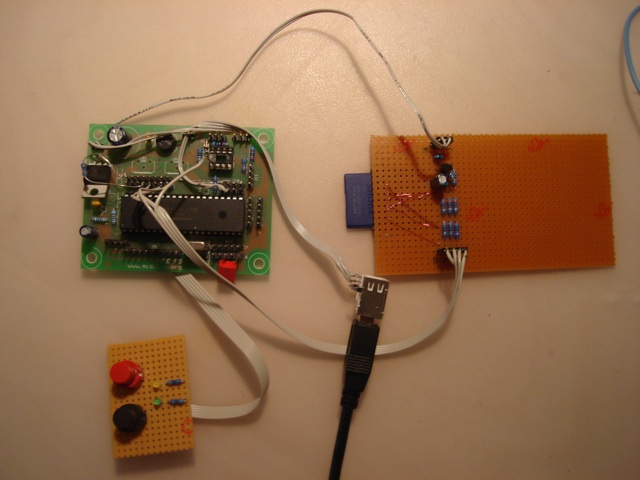
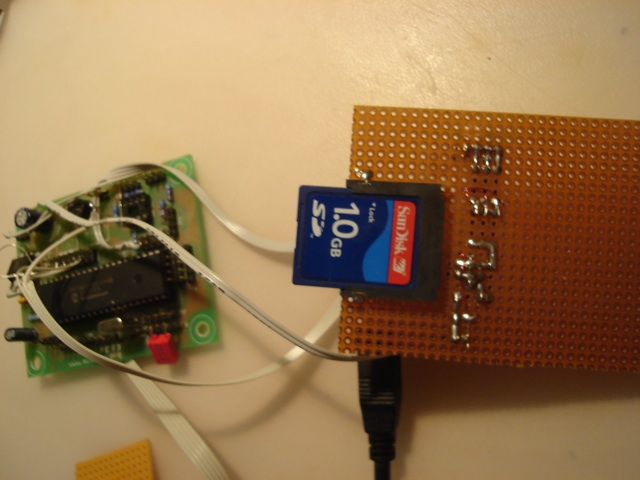
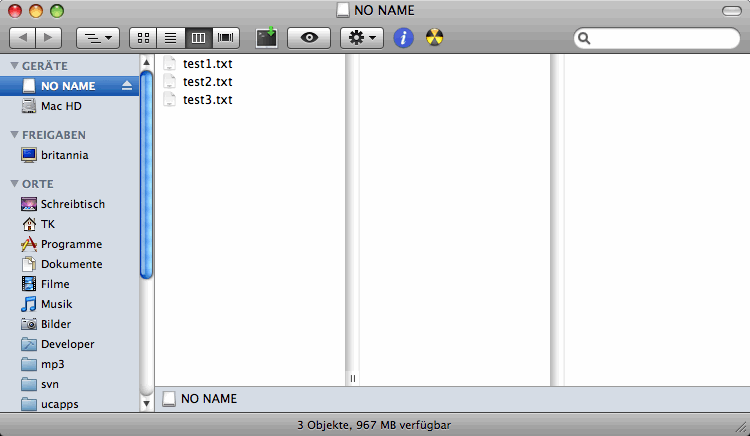
I quickly soldered a prototype board, and uploaded the example application for a “mass storage device” (AN1003).
The C code which accesses the SD card looks simple. However, the challenge will be to make the code small enough, so that it fits into existing applications (w/o USB support of course). It also makes sense to use the bitbanging method instead of SPI peripheral for higher GPIO flexibility (speed doesn’t really matter, considered that a SD card is already much faster than a IIC EEPROM)
I think, that it can be easily re-written in assembly, and provided as a MIOS Module
Best Regards, Thorsten.
…just leaves me speechless - as so often. This sounds GREAT!
Best regards, ilmenator
awesomeness!!
woohoo!
that is gonna rock
Sweeeet ;D This’ll be fun.
1Gb will be enough…
I know it is early days at the moment but… TK do you know what pins you may use for this? I’m doing some designing right now and would like to be sure I leave room for this baby
I’ve started arranging an order of 25+ SD sockets too, so we should have enough for people to do some testing when it comes to that.
hello
the link that made me found it:
http://jeanfrancoisdelnero.free.fr/floppy_drive_emulator/index.html
and this demo on a korg dss-1… :o
http://www.reflexmusic.de/DSS-1/
sorry guys i don’t understand about how it works… ???
mios>sd …WOW !
hello
has anybody know that link?
http://jderogee.tripod.com/project1541.htm
wonder if it works with my sp-12 ::)…or to load games on c64!
I brought up the idea of doing a group buy for this on the cctalk mailing list some time ago. It kinda fizzled out. Still, I’d like to get one of these eventually.
I know it is early days at the moment but… TK do you know what pins you may use for this? I’m doing some designing right now and would like to be sure I leave room for this baby
I’ve started arranging an order of 25+ SD sockets too, so we should have enough for people to do some testing when it comes to that.
It’s much too early to prepare SD card support for applications, because I’m still in the evaluation phase. Meanwhile I’ve written routines to read/write sectors, but it’s still unclear to me, if FAT support is feasible for applications like MBSID, because it requires a lot of additional code. Maybe with some dirty programming tricks it will be possible…
Means in other words: it’s a piece of cake to use a SD card as BankStick replacement, but once you want to transfer files to/from a computer as well (-> FAT support), a solution which works flexible enough probably gets too complex.
Some useful resources I found:
FAT16 driver by Roland Riegel: http://www.roland-riegel.de/sd-reader/
FAT in a nutshell: http://home.teleport.com/~brainy/fat16.htm
A very geeky SD socket replacement by Rob Wentworth: http://uanr.com/sdfloppy/
The last side confirms, that data input and output can easily be merged to a single line, which means, that only 3 GPIO pins are required (one dedicated pin for CS#, two pins for clock and data IO). The upcoming sdcard driver will allow to freely assign the pins to GPIOs
I won’t have the time to continue the evaluation in the next two weeks, but you can be sure that SD cards will be supported in future (I will open a new thread later). A nice demonstration project would be a MIDI file player, but it could also be a MIDI stream recorder
Best Regards, Thorsten.
TK, have you considered using CF cards instead to take advantage of their greater access speeds?