Nice find. I actually ran into it as well on my search. But figured that the software restriction would render it useless for our purpose. Hope you get somewhere with getting acces to their protocol specs.
I got bad news from them last week : they do not want to disclose their protocol… Technically, it would be possible to reverse the protocol, but it’s probably a huge task. And I am afraid that they run a complete application in the DSP by default, which is only parameterized from the PC (so not possible to upload a new firmware in the DSP)
However, I am still convinced that we can do something… and I will probably finish by making my own PCB for the DSP 
And still about DSP, I also have something in my mind that I will submit to MB group very soon… Too early to reveal it for now, but I am sure that it will get interest from the community (with RTP-MIDI fully involved of course :shifty: )
And if any MB member goes to Frankfurt Musik Messe, do not hesitate to come on KissBox booth, I will be very happy to meet you there (we are on booth B93 in the Pro Light and Sound building)
How many DFTs can a mutli-GHz, multicore ARM board manage? Surely that’s the competition at this price point, not an STM32? It’s also not clear how well optimised the DFT code under comparison was, or whether it leveraged NEON, etc.
How many DFTs can a mutli-GHz, multicore ARM board manage? Surely that’s the competition at this price point, not an STM32? It’s also not clear how well optimised the DFT code under comparison was, or whether it leveraged NEON, etc.
It’s pretty hard to tell, especially when the compiler is dealing with NEON. By the way, I do not think NEON was involved in the DFT test described before.
The difficulty is that the gap between “general use” CPU and DSP is becoming smaller and smaller. Most CISC CPU now have dedicated DSP instructions (NEON or anything else), and many DSP integrate a general CPU (take a look to XMOS for example : they now provide a XCore chip with a ARM coprocessor! Same thing for Analog Device, with the BlackFin DSP.
What is sure is that DSP cores are still beating all general use CPU in terms of pure DSP processing power, since they have an highly optimized architecture, most of the time with parallel FPALU, address generators, etc.. For example, a SHARC can execute up to 6 instructions in one cycle when the SIMD engine is activated, giving 2400MIPS peak power for 400MHz clock.
The biggest challenge for now with the DSPs is the cost of the development chain…
Hi Benoit,
It is hard to tell if the plugiator asx/ icon x-synth is still under consideration for you, but I noticed they are ~130 euros on amazon.de
cheers,
justin
Hi Justin,
thank you for the information. I see that there are 4 pieces, available but they say “more are coming” (mehr ist unterwegs)
If they are able to get more, then Amazon would become an interesting source for the project. The only problem with the X-Synth is that it is delivered only with 4 DSP programs (Minimax, B4000, Vocoder and an ARP emulation - can’t remember which one). The other “plugins” are supposed to be available on Use Audio website, but not sure they can fit in the X-Synth (even if the X-Synth is *exactly* the same as the ASX. They are both made by inDSP)
To be honnest, I know a way to unlock them, but this requires to “tweak a little” the PCB (the ATMega32 must be inhibited and you must load the binary file directly in the DSP from the MBHP). The problem is that any single error “kills” the board (the microcontroller becomes unresponsive). If any of you is interested by this tweak, just ask…
So what happened to the announcement on the frankfurt messe? I did some googling, but couldn’t find much.
I bought all the extra plugins for a cheap price, so no need here 
Which announcement ?
I bought all the extra plugins for a cheap price, so no need here
The problem wth the UseAudio / iCon plugins is that they are signed. You have to provide the serial number of the board when you connect to the website, and you can upload the DSP binary file only to the board with the same serial number.
They protect themselves against piracy with that (and that’s normal!), but this becomes a serious problem when your board dies and you want to replace it. I got the problem two times in the past: one of the first ASX board I bought stoppped working one day. It was replaced by the vendor (Thomann), but I was unable to reload the option plugins because the board had a different serial number, so my codes were not working anymore.
The second time was simply because the manager software provided by Use Audio is simply awful, especially on the Mac platform, and I was suddenly unable to reload a ASX which was crashing because of a corrupted file (for those who read French, take a look to Audiofanzine website, I explain there what happened and how to recover the board)
Benoit
Hi,
for those interested by the technical details of the ASX board, I have manually redrawn the schematics. I have uploaded them here, in order to help any forum member who wants to recycle the ASX.
The schematics are only intended to understand how the ASX can be used with other DSP firmware than the one available from iCON and Use-Audio. Note that the schematics are not complete (missing power supply and a few lines between the DSP and the codec), and I can not guarantee they are exact.
The ASX, the iCON and the Plugiator are based on the same DSP board (the only difference is that Plugiator contains an extra CPU to handle MIDI, knobs and display)
As you can see on the schematics, you have a direct MIDI IN on J1 (used for connection with CME UF keyboard) and J4 (used for connection with CME VX keyboard). These are “true” MIDI link, not TTL level. They can be driven directly by a MIDI OUT of a MBHP.
During my investigations, I discovered some details about the MIDI protocol and the SPI protocol between the DSP and the ATMega32. These are just notes, but I can share them with any member who wants to implement a ASX synth controller based on MBHP.
Benoit
[ASX schematics.zip](< base_url >/applications/core/interface/file/attachment.php?id=12019)
Dear Benoit
Thank you very much for sharing your findings rel.to the ASX board!
Kind regards
Jo
Wow, just discovered this :
the XSynth is sold for 141 euros by Woodbrass : http://www.woodbrass.com/product_info.php?products_id=103640&af=2013
Amazon sells the same product for… 300 euros!!! :mad: http://www.amazon.fr/Icon-208167-X-synth/dp/B003YULO76
(By the way, I discovered that Amazon performs some absolutely funny translation from iCON datasheet. For those who read French, take a look at Amazon webpage, it’s absolutely crazy to read… and it’s completely false!!! The XSynth is not General MIDI, and it’s far, far away from 126 layers :geek: )
I also discovered this other board from iCON : the G-Synth. It seems to be a Grand Piano module, not sure it’s the same PCB, but it seems to have many similarities (same DSP and RAM chip)
For those interested, I am building right now a crappy demo around the MBHP NG and one of my ASX… Plugiator is coming back :devil:
Benoit
A detail about the iCON and ASX : I just found that they do not look exactly the same (I have only ASX boards, so I made comparison with pictures of the iCON)
The PCB is slightly different around the power supply area. On the ASX, there 3 connectors JST XH connectors (two XH-4 and one XH-8), while the X-Synth has a HE10 10 pins male connector
The J1 connector is also not installed on the ASX, while the X-Synth has a XH-8 installed.
I noticed that I made some slight errors on the schematics I published here (wrong number on connectors), I will upload a corrected version as soon as I have finishe the prototype
Great news : it’s possible to get an iCON X-SYNTH for 19 EUROS !!!
Look here : http://www.woodbrass.com/synthe-option-tiseur-icon-x-synth-dsp-p103640.html
For this price, I bought two, and I have update the schematics to show what is the exact difference between ASX and X-SYNTH… Finally, it’s the model of a connector which change. A JST-XH8 is replaced by a HE10 with 16 pins. No more, no less.
I just needed to make an adaptor to be able to switch from ASX to iCON, the MIDIBOX firmware I wrote for my ASX did not need to be changed in any way.
Be patient, I will publish tomorrow the photos of the prototype and make you listen to the sound of this marvelous little board. The firmware still needs some work, but I will publish soon a complete description of the project based on the MBHP RTP-MIDI (so fun to drive the Minimax over a RTP-MIDI network :rolleyes: ). This is probably one of the first widely available RTP-MIDI synthesizer available by the way
By the way, I have updated the schematics for all members being interested. These schematics show the difference between the ASX and the X-SYNTH (first page of schematics).
For those being interested, I still have a few MBHP PCB for sale, if you want to build this synthesizer.
Benoit
[ASX_Schematics_V1_R2.zip](< base_url >/applications/core/interface/file/attachment.php?id=12068)
And as promised, here are the pictures of the quick and dirty prototype I made to show how to use the ASX and the X-Synth boards along with the MBHP.
As you can see, the only difference between the two boards is the connector used to attach it to the MBHP. The prototype is not designed to look pretty, but just to help me to write and test the MIOS application to control the boards.
The connector you see on the X-Synth is not the correct one. It should a HE10 connector, but I ran out of them, so I made a cheap adapter.
The RTP-MIDI board is installed under the display, so you can control the synthesizer from DIN, USB and RTP-MIDI too.
Note that there is a small control panel with 8 push buttons to navigate in the menus and 8 potentiometers, but I did not connect it when I took the pictures, to avoid a mess of cables in the middle of the photo.
I will check with Thorsten how we publish the technical description and the firmware, maybe I will start a dedicated topic for it.
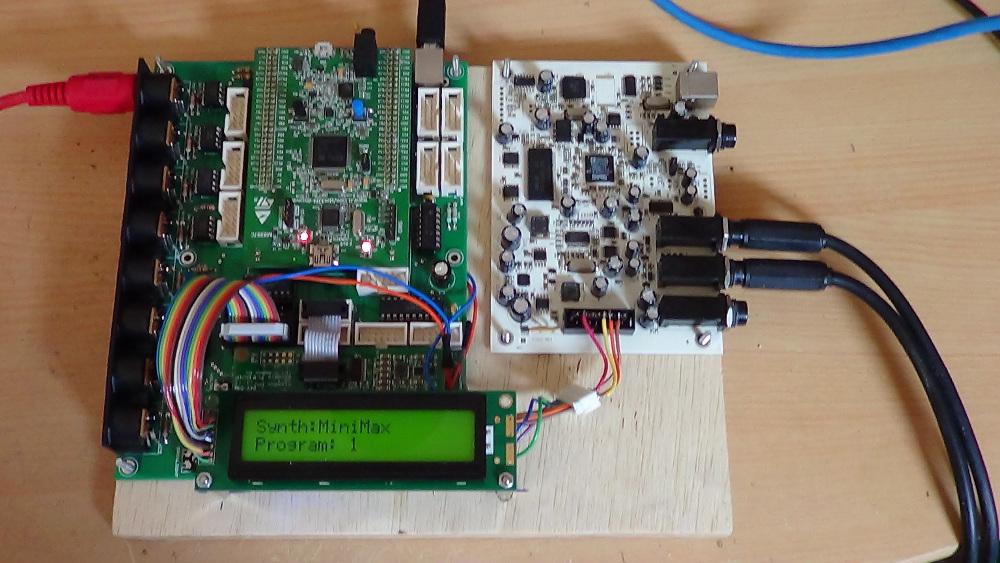
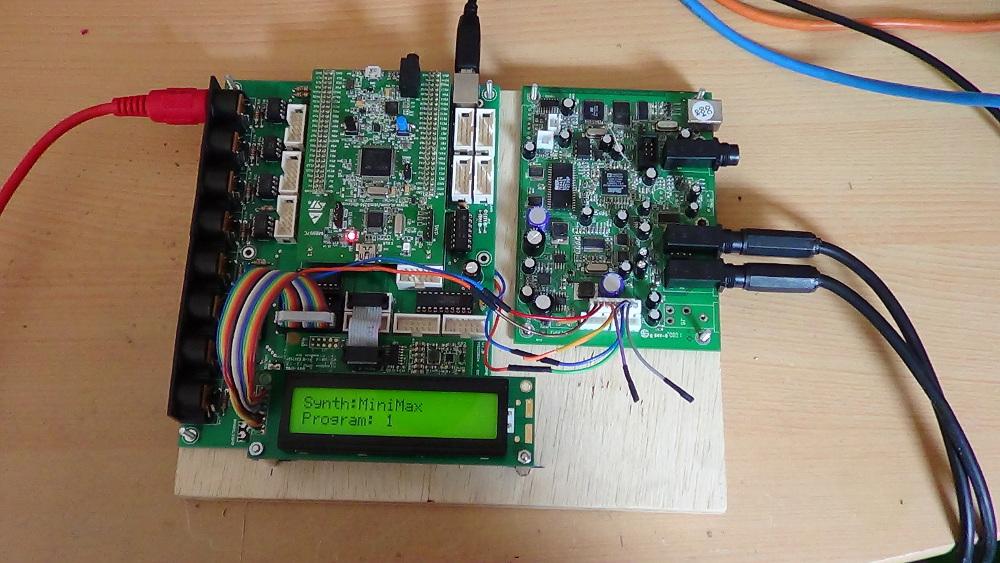
With the prototype, can you just control parameters? or are you able for example to switch from minimax to b4000?
As you can see on the display, you can change the synth model (so yes, you can switch between Minimax, B4000, Lightwave, etc…). And I can edit parameters too (even if this functionality is still very basic for now, because of the multiple differences between the different synths. Moreover, my ASX is fully loaded, I have all the synths in it : Prodyssey, P12, FMagia and Drums&Bass, each of them having a completely different control matrix…)
To give you a little bit more detailed explanation about my approach (since you can’t see the push buttons. In all of the synths I design, I have 3 modes : PERFORMANCE, EDIT and UTILITY. Here, with the performance mode, you can choose the synth model (using the PARAMETER+ and PARAMETER- push buttons, then validate with ENTER button). The DATA+/DATA- buttons allow you to load a program.
In EDIT mode, you have access to “quick edit” in which you can change directly a parameter value using the 8 potentiometers. You have a set of pages for direct access to the most common parameters (cutoff, resonance, EG, etc…). All “specific” parameters are reached using a menu on LC display.
I am preparing a small video to show how this is working (and to hear some sounds from the ASX board), it should be easier to understand
Ah ok, that’s pretty cool. That would completely remove the need for a pc.
So i guess by firmware you mean the dsp code that normally is uploaded through the software of UseAudio. I would recommend not to distribute that for obvious reasons
Ah ok, that’s pretty cool. That would completely remove the need for a pc.
Yes, that’s exactly the first reason I wanted to build a synth around this board. It was mainly designed to be used in a master keyboard but connected to a PC via USB.
Honnestly, this board has incredible sound (the Minimax and the optional P12 being the best imho), but the way they designed the integration within DAW is… hummm… And their VST plugins were absolutely horrible to use (just imagine that the first version of the plugin manager was based on Flash :wacko: )
So i guess by firmware you mean the dsp code that normally is uploaded through the software of UseAudio. I would recommend not to distribute that for obvious reasons
Oh, there is a misunderstanding here. The way I am using the board is still involving the normal firmware (the ATMega on the board loads the DSP locally, the DSP is not loaded by the MBHP). The MBHP is used for controlling the board via MIDI/RTP-MIDI and help edition.
There is no copyrighted code involved anywhere
What I explained earlier in the post is another topic on which I am working since a long time. The idea is to disconnect the ATMega from the SHARC DSP and load custom DSP code in place of the microcontroller. But this is pretty hard to do (there is a SMD quad resistor to unsolder, and this is not something for beginners)
And I would not distribute any original binary file for the DSP (it is not needed to reload the DSP anyway, since the edition tool provided by UseAudio or iCON allows to reflash the board if needed), and I will not provide the binary files of the optional firmware, sorry :zorro:
Seriously, since I have a licensed VisualDSP toolchain (needed to make custom code for the DSP), my idea is to use the board as a “ready to use” DSP with any firmware written by me or other VDSP users
Hi
Thanks for all this informations.
I have an Icon X-Synth and I’m looking for your schematics.
On SV2 connector in X-synth, can I plug, on MIDI_IN_VXP and MIDI_IN_VXM, a direct cable from MIDI IN DIN connector, or from a TX pin microcontroller ?