Look great !!!
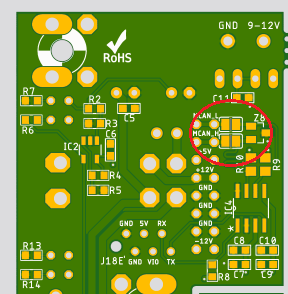
so J18 for MCAN ?
Best
Zam
Look great !!!
so J18 for MCAN ?
Best
Zam
Just now, Zam said:
Look great !!!
Thanks! 
Just now, Zam said:
so J18 for MCAN ?
Yes for CAN, J18 is always the one. But Andy’s wCore and Disco platform have only One-Wire connection. This one has Power pins for transceiver supply, RX and TX are separated. But you can add the regular Resistor and a Diode on the dipBoardF4 to link others Cores directly and easily with the One-Wire.
This MCAN connector may be called J18E for ‘extended’ I suppose…
A small transceiver module will be created to link the CAN bus with the external world, internally I planned to use the Euro Power connector, the power ribbon by using BUS1 and BUS2(last pins of the 16pins IDC) called CV and GATE sometime but never used in fact.
Best regards
Bruno
On 12/10/2019 at 4:50 PM, Zam said:
so J18 for MCAN ?
I finally decided to add CAN transceiver to the board.
The modules will be able to communicate natively in midi thru the regular euro power supply ribbon, using MCAN. No need of an other board to connect to the external world too, just a connector in front which will give access to the lines MCAN_L and MCAN_H.
Best regards
Bruno
If you didn’t already, add jumpers to the CAN pins in case the buss is used in the conventional manner (CV/gate). Putting a high-speed digital signal on the power cable might introduce some crosstalk and should be tested.
Hi Andy,
First thanks for taking a look.
1 hour ago, latigid on said:
If you didn’t already, add jumpers to the CAN pins in case the buss is used in the conventional manner (CV/gate).
I didn’t but I will add those jumpers. It’s a good idea, it adds more flexibility. Done!
1 hour ago, latigid on said:
Putting a high-speed digital signal on the power cable might introduce some crosstalk and should be tested.
CAN(with transceiver) is a differential pair signal, then bad behaviour like crosstalk to power and audio paths should be very limited, but you’re right this has to be tested, noted!
Best regards
Bruno
2 hours ago, Antichambre said:
I finally decided to add CAN transceiver to the board.
that’s definitely even better
Best
Zam
Hi all.
Bruno - great work! I was wondering a couple of things:
1 - is a DIY kit for a desktop version already available?
2- is there any way to have patterns which are not playing constantly (I don’t know how to describe it)? Like a pattern in which you have the first two 16th notes being played, then 1 paused, then again 3 played, and so on…
3 - how much patterns can be saved in total on the SD card?
I think this is it for now… 
Thanks and regards,
Flavio.
Hi and thanks Flavio,
8 hours ago, FlavioB said:
1 - is a DIY kit for a desktop version already available?
In January, for a handful of beta testers, because I need some feedback before releasing first version firmware.
PCB are the same for both version(Euro/Desktop).
Euro Front panels will be ready first, before the desktop enclosure which is more complicated.
8 hours ago, FlavioB said:
2- is there any way to have patterns which are not playing constantly (I don’t know how to describe it)? Like a pattern in which you have the first two 16th notes being played, then 1 paused, then again 3 played, and so on…
I think you will be able to do something like that, there’s the possibility to mute the notes in the Notestack editor. But result depends on the MOTIF used, means for example, if the MOTIF is UP&DOWN and one note is muted, this note will be muted 2 times, in the ascending part and in the descending too.
But it’s not a sequencer It’s an arpeggiator
9 hours ago, FlavioB said:
3 - how much patterns can be saved in total on the SD card?
There’s no limitation for saved Sessions on the SD-card. A Session is 8 Banks of 8 Presets of 8 Voices.
I hope I answered to your questions
Best regards
Bruno
Hi Bruno… I tried in vain to quote as you did  Sorry!
So here we go, therefore…
1 - will there be any list on which one will have to sign up to get the whole package?
2 - I was thinking about the “rest” feature which is present in the ARPIE Arpeggiator –> https://www.youtube.com/watch?v=JJFHf_Ribx4 (at 1:09 you see it).
3 - great!
Thanks,
Flavio.
19 hours ago, FlavioB said:
I tried in vain to quote as you did
Right click and wait you will get the “quote it”
19 hours ago, FlavioB said:
1 - will there be any list on which one will have to sign up to get the whole package?
Not for the moment, but you already follow this topic, that’s fine
19 hours ago, FlavioB said:
2 - I was thinking about the “rest” feature which is present in the ARPIE Arpeggiator –> https://www.youtube.com/watch?v=JJFHf_Ribx4 (at 1:09 you see it).
I don’t understand how it works exactly, even with the video. With the HAARP, the resulting sequence have a variable length, depending on MOTIF/RESYNC/LOOPS and the notestack length(10 notes Max), this resulting sequence(the full loop) can easily exceed 16 steps(HARPIE), so it’s difficult to do the same feature.
But don’t worry the velocity can be animated too, with the TARGET feature, and more precisely than a ON/OFF or an accent system, in my opinion, a little more musical yet.
Best regards
Bruno
OK, maybe you put this feature on the “wishlist”, it’s not mandatory but it’s for sure nice once you start playing around with it. Honestly I’ve sort of “abandoned” the ARPIE because it has no memory! You power it off and all your settings are gone This is why I’m looking out for a similar unit, but with patch memory (like yours).
I’ll be waiting…
F.
beautiful work!! sit patiently in corner with hands up to hopefully get to buy one in the new year
same here!!
Great work
On 26/11/2019 at 6:05 PM, FlavioB said:
OK, maybe you put this feature on the “wishlist”, it’s not mandatory but it’s for sure nice once you start playing around with it.
I had a look, have to test it. It’s easy to implement it on the harpie cause there’s no preset, the thing you dislike on it. On the HAARP a full session is loaded in RAM, to permit the user to work on the whole session in a non-destructive fashion. If I add this feature I have to add a 32bit word to each voice(8x8x8) in the structure as we can save it or it has no sense to add it, it’s 2K to find in ram just for this. More than that it obliges me rethink a part of the processing.
So if I do it, I’ve got to do it now, to choose now, this is not something I will be able to add later, and it needs to change the structure of the session, means old presets you made without will be not compatible anymore if I add it later(Except if I implement a versioning and translating process huge)
I will try and spend some time for that, even if it delays the first release.
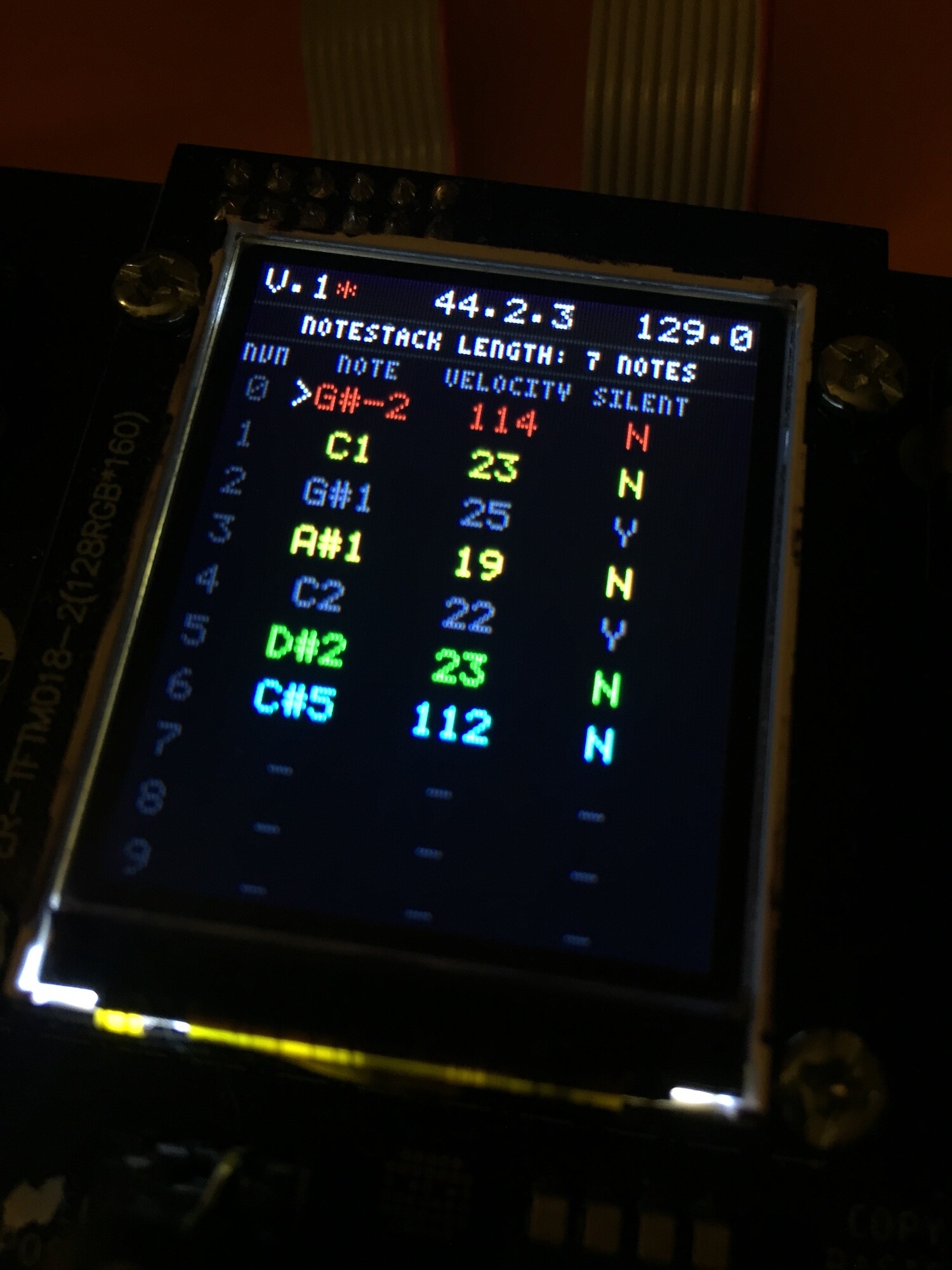
Under construction note stack editor
Best regards
Hi Bruno. Many thanks for looking into it - I would really love to see it in the final firmware!
Let me know if I might be of any kind of help (even if it’s just showing you how the ARPIE does its thing…).
BR,
Flavio.
Just now, FlavioB said:
Let me know if I might be of any kind of help (even if it’s just showing you how the ARPIE does its thing…).
I think I understood how it works, in my case it’s worst than I thought this needs more than 32 muting bits. A u32 word is not enough.
If notestack(10notes) is fully filled and the motif is a PINKY UP&DOWN or THUMB UP&DOWN the sequence achieves 36 steps for example…
I added 2 u32 words for each voice, it’s a 27Kbytes session now instead of 23, and it’s fine even with the bitmaps of the TFT which are rather greedy
I think I will not add it as a list like the notestack EDIT but directly in the HOME page(piano-roll) it will avoid me to modify the process, no need of pre-calculation of the whole sequence.
In fact thank you, it will be a great feature… And there will be a “Resting Steps feature requested by FlavioB” somewhere in the code
Best regards
Bruno
Hey Bruno! That’s very good news!
And thanks for crediting me for the input That’s really sweet!
I definitely want the desktop version of HAARP as soon as you release it. DIY or already assembled (preferred, but not mandatory, as I have a good friend who’s doing DIY for me and himself).
THANK YOU!
F.
2 hours ago, FlavioB said:
THANK YOU!
Done!
// Voice Structure typedef union { struct { u8 ALL[1+(sizeof(notestack\_item\_t)\*ARP\_NOTESTACK\_SIZE)+8+1+7+6+3]; }; struct { u8 notestack\_len; notestack\_item\_t notestack\_items[ARP\_NOTESTACK\_SIZE]; u32 resting\_steps[2];// Resting Step Feature(RSF) requested by FlavioB ;) arp\_par\_func\_t func; arp\_par\_timing\_t arp; arp\_par\_trans\_t trans; arp\_par\_vel\_t vel; }; } arp\_voice\_t;
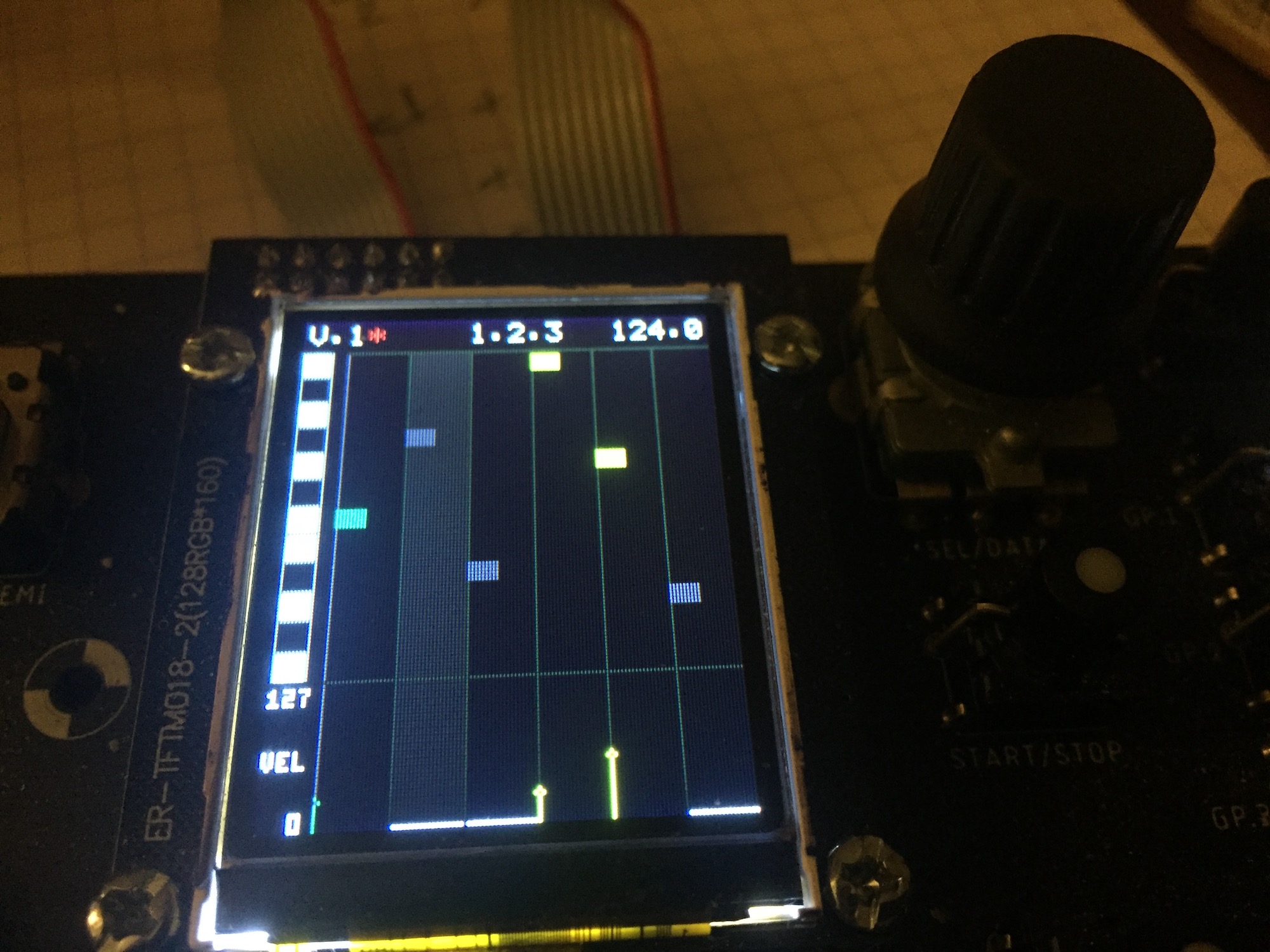
Then this is how it works:
The selected step for Resting Step Feature(RSF) is the one with grey background, you can move this selection with the encoder.
(Initially the encoder was used for TEMPO, but tempo is the altered function of the encoder now(with ALT button), and RSF is the main function of the encoder)
Pushing the encoder(switch) is toggling the RSF for the selected step. then a white bar appears at the bottom of the velocity and the semitone becomes grey.
HOME button + Encoder Switch is clearing all the Resting Steps.
Note: If an HID keyboard is connected:
Left/Right Arrow for selection.
Up/Down Arrow or Enter for Toggling
Del/BackSpace to Clear All
… And this is not a legend, it already works
Voilà!
PS: Shooting a picture of a TFT with an iPhone is a bad thing Colors are really better in real
Best regards
Bruno
Damn! You’re lightning fast in coding! GREAT THING!
Will you also demo this feature with a short video?! :-p
Really really appreciate this!
F.
Just now, FlavioB said:
Will you also demo this feature with a short video?! :-p
Yes but I left the country, I’ve got the HAARP with me to work on at night but I’m somewhere in an hotel in Africa, connection is not good.
So when I will be back home…